
Lighting 101:
Balancing Flash With Ambient, Pt 2
Abstract: More light balancing! With a little practice, you can balance a flash with pretty much any light source — from full sunlight, to a starry night.

(Photo by Strobist reader Brent Williamson)
Okay, now let's get out of the shade (or the indoors) and do battle against full sun with our off-camera flashes...
When last we met, we talked about the idea of balancing flash with ambient. We were using the flash as a main light and the ambient as fill, but you do not always have to do it that way.
Straight fill flash is very simple these days, with TTL flashes doing the heavy lifting (i.e., thinking) for you automatically. But doing it the easy way usually means keeping the light on the camera.
The goal here is to start to replace the blah concept of 'fill flash' with that of 'balancing light.' And, more important, to separate the idea of fill flash fill/balance from the rote use of on-camera flash.
The process of using flash to augment (which is a better concept than fill) sunlight is very straightforward. First you are going to start at your camera's highest synch speed, because that'll get you the most flash-friendly aperture. And thus, the most flexibility from your small flash. While you're at it, dial your ASA down as low as it will go to get better quality, too.
Now think about your lighting direction and angle. As opposed to the idea of fill flashing, on-camera, from any angle outside without regard to the sun's direction, using a strobe on a stand effectively gives you two lights to play with. You can balance. You can cross light, You can do both. You'll have more flexible (and consistent) results using this approach.
When you just fill flash from on-camera, true, it does bring up the shadows. But while the flash adds detail it really misses out on the opportunity to improve the depth and quality of the light. So why not do both at the same time?
Step one: Think of the sun as your main light source, and your strobe as a secondary light. You are not just getting rid of raccoon eyes now. You are working with two lights. You have flexibility. You might even have style.
Choose your angle of attack. Maybe you have the sun behind you (on the left side) at a ~45-degree angle. Why would you have your fill on on camera when it might look better lighting from the upper right? On-camera flash limits you. Avoid it if you can.
Maybe you turn the angle around and shoot the subject in profile. Say he is facing to your right. You could have him looking into the sun, which is angled to come from slightly behind his face to provide rim light that is nice, but way too contrasty as is. Just move your strobe over to the left side, elevate it a little, and you have a cool-looking, two-light setup.
That's exactly what I did for this quick portrait of the son of the exiled Shah of Iran, made for The Baltimore Sun:
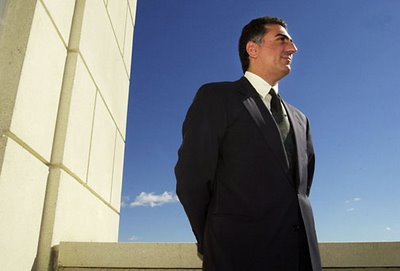
Whatever the angle, the technique for balancing is the same. We are basing the exposure on the ambient this time, and bringing the flash up to fill shadows and/or provide light from another direction.
Assuming a sunny ambient light level to balance, set your camera at the highest synch speed (i.e. lowest aperture) to provide a lower aperture and ease the burden on your flash. Now, get your base (ambient) exposure. We'll call it a 250th at f/11 at ASA 200 for the sake of argument.
Now, with your strobe on manual and on a stand, set it to somewhere around a quarter to half power if you are working close. Maybe half to full power if the flash is further away. If you are not lighting a large area (and you usually are not) zoom the flash to a 70mm or 85mm lens angle to make it even more powerful.
Pop a test frame and eyeball it. If your flash-lit area is too bright, dial the flash down or move it back. If it is too dark, dial it up or move it forward.
The thought process is the same whether you are balancing sunlight or starlight. (And when you think about it, sunlight is starlight, isn't it?) Just start with a good ambient exposure — in this case, exposing the stars — add a little flash to give detail where you want. In this case, the underside of a natural arch:
 (Photo by Strobist reader Joe Stylos)
Since we are not exactly swimming in ambient light here, the starting point will be a little different. Instead of 1/250th of a sec (or 1/200th, whatever) to control the sun, we'd probably wanna start with our lens wide open and choose a pretty high ISO to get the fastest reasonable shutter speed for the night sky.
Solve your most pressing variable first, then go from there. The process is the same.
__________
The important thing to remember (and why I told you the angle stuff first) is that this is now a starting point to turn your outside "fill" strobe into a true, useful second light source. Experiment.
I used to practice my outdoor lighting skills any time I was assigned to shoot a simple headshot, AKA a mugshot, for the paper. What you have to remember is that they don't know you could do a perfectly good job by just sticking them in the shade for 30 seconds and bolting. Muah-ha-ha, you are now my lighting model for 15 minutes...
Outside? Play with fill light and angles. (You might want to grab something safe in the shade first just in case.)
Inside? Set up a quick umbrella in a corner where one wall is your background and another is your fill card.
I'd turn a mug shot into a head shot, which is just a more professional way to do it. I would get some good (low-pressure) experience with my lighting. And they'd look better in the paper. It's a win-win.
And, contrary to what you might think, most people will be secretly flattered by the effort you are putting in to making a better photo of them.
And one more thing. For you newspaper photogs, stop thinking of them as mug shots from this point forward. Areporter trained monkey can do a mug shot. Start shooting head shots. You'll improve your quality and get into a habit of using light effectively.
Next: Using Gels to Correct Light
(Photo by Strobist reader Brent Williamson)
Okay, now let's get out of the shade (or the indoors) and do battle against full sun with our off-camera flashes...
When last we met, we talked about the idea of balancing flash with ambient. We were using the flash as a main light and the ambient as fill, but you do not always have to do it that way.
Straight fill flash is very simple these days, with TTL flashes doing the heavy lifting (i.e., thinking) for you automatically. But doing it the easy way usually means keeping the light on the camera.
The goal here is to start to replace the blah concept of 'fill flash' with that of 'balancing light.' And, more important, to separate the idea of fill flash fill/balance from the rote use of on-camera flash.
The process of using flash to augment (which is a better concept than fill) sunlight is very straightforward. First you are going to start at your camera's highest synch speed, because that'll get you the most flash-friendly aperture. And thus, the most flexibility from your small flash. While you're at it, dial your ASA down as low as it will go to get better quality, too.
Now think about your lighting direction and angle. As opposed to the idea of fill flashing, on-camera, from any angle outside without regard to the sun's direction, using a strobe on a stand effectively gives you two lights to play with. You can balance. You can cross light, You can do both. You'll have more flexible (and consistent) results using this approach.
When you just fill flash from on-camera, true, it does bring up the shadows. But while the flash adds detail it really misses out on the opportunity to improve the depth and quality of the light. So why not do both at the same time?
Step one: Think of the sun as your main light source, and your strobe as a secondary light. You are not just getting rid of raccoon eyes now. You are working with two lights. You have flexibility. You might even have style.
Choose your angle of attack. Maybe you have the sun behind you (on the left side) at a ~45-degree angle. Why would you have your fill on on camera when it might look better lighting from the upper right? On-camera flash limits you. Avoid it if you can.
Maybe you turn the angle around and shoot the subject in profile. Say he is facing to your right. You could have him looking into the sun, which is angled to come from slightly behind his face to provide rim light that is nice, but way too contrasty as is. Just move your strobe over to the left side, elevate it a little, and you have a cool-looking, two-light setup.
That's exactly what I did for this quick portrait of the son of the exiled Shah of Iran, made for The Baltimore Sun:
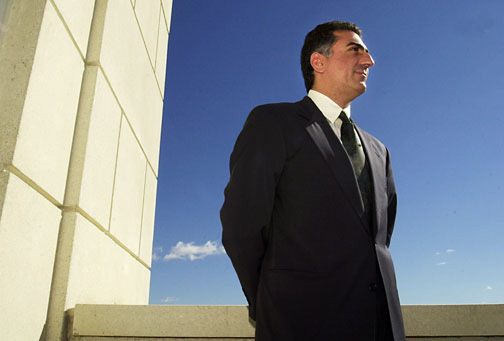
Whatever the angle, the technique for balancing is the same. We are basing the exposure on the ambient this time, and bringing the flash up to fill shadows and/or provide light from another direction.
Assuming a sunny ambient light level to balance, set your camera at the highest synch speed (i.e. lowest aperture) to provide a lower aperture and ease the burden on your flash. Now, get your base (ambient) exposure. We'll call it a 250th at f/11 at ASA 200 for the sake of argument.
Now, with your strobe on manual and on a stand, set it to somewhere around a quarter to half power if you are working close. Maybe half to full power if the flash is further away. If you are not lighting a large area (and you usually are not) zoom the flash to a 70mm or 85mm lens angle to make it even more powerful.
Pop a test frame and eyeball it. If your flash-lit area is too bright, dial the flash down or move it back. If it is too dark, dial it up or move it forward.
The thought process is the same whether you are balancing sunlight or starlight. (And when you think about it, sunlight is starlight, isn't it?) Just start with a good ambient exposure — in this case, exposing the stars — add a little flash to give detail where you want. In this case, the underside of a natural arch:
Since we are not exactly swimming in ambient light here, the starting point will be a little different. Instead of 1/250th of a sec (or 1/200th, whatever) to control the sun, we'd probably wanna start with our lens wide open and choose a pretty high ISO to get the fastest reasonable shutter speed for the night sky.
Solve your most pressing variable first, then go from there. The process is the same.
__________
The important thing to remember (and why I told you the angle stuff first) is that this is now a starting point to turn your outside "fill" strobe into a true, useful second light source. Experiment.
I used to practice my outdoor lighting skills any time I was assigned to shoot a simple headshot, AKA a mugshot, for the paper. What you have to remember is that they don't know you could do a perfectly good job by just sticking them in the shade for 30 seconds and bolting. Muah-ha-ha, you are now my lighting model for 15 minutes...
Outside? Play with fill light and angles. (You might want to grab something safe in the shade first just in case.)
Inside? Set up a quick umbrella in a corner where one wall is your background and another is your fill card.
I'd turn a mug shot into a head shot, which is just a more professional way to do it. I would get some good (low-pressure) experience with my lighting. And they'd look better in the paper. It's a win-win.
And, contrary to what you might think, most people will be secretly flattered by the effort you are putting in to making a better photo of them.
And one more thing. For you newspaper photogs, stop thinking of them as mug shots from this point forward. A
Next: Using Gels to Correct Light
__________
New to Strobist? Start here | Or jump right to Lighting 101
Now available in audiobook: The Traveling Photograher's Manifesto
Permalink


<< Home