On Assignment: Star Gazer

We all have our
Didn't need much flash here. One quarter power (on manual) and the coverage angle on the flash set to 24mm for a nice, wide throw.
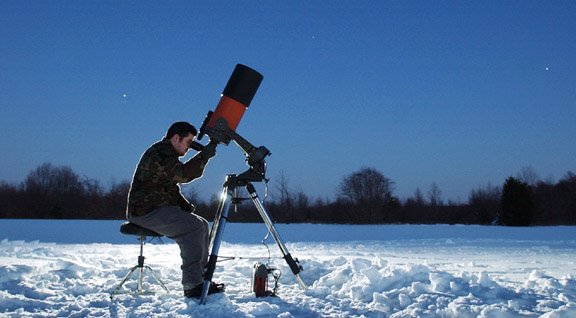
The flash is directly behind the guy. If you look closely, you can see the feet of my stand peeking out. In retrospect, I could have easily glopped some snow in front of the feet to hide them. Oh, well. Next time.
Again, the flash is doing double duty by separating the guy with a rimlight and lighting the snow for a good contrast against the twilight sky. But it is also providing fill for the guy's face by bouncing up off of the snow, which is a very efficient reflector.
It was getting pretty dark at the time, so I had the flash on the light stand backwards (with the head turned back around towards me) so the ready light would be visible. This told me that (a) the flash was charged and (b) where, exactly, the flash was so I could position myself to hide it behind the guy while working in dim light.
Camera: Nikon D1h
Lens: Nikkor 17-35 zoom, slow shutter speed @ f/2.8
Flash; Nikon SB-28 on light stand behind guy
Quarter power; 24mm throw
Sync: Pocket Wizard remotes
©David Hobby / The Baltimore Sun
Next: Real Estate Developer


6 Comments:
appreciate all the info you share with us, but...
[But it is also providing fill for the guy's face by bouncing up off of the snow, which is a very efficient reflector.]
how can the one flash _behind_ the guy throw fill light onto the guys face facing the other side??
Well, look at all that snow. Suppose that guy looks away from the flash, and it is triggered - is the flash going to be completely invisible to him? Or is the snow going to reflect some light back into his face so that he can see that the flash went off?
I think the face of the guy got enough light due to the slow shutter speed... correct me if I'm wrong though.
If the surface of the snow had been completely level, there would have been no light from the strobe reflected back onto the camera side of the man's face. Notice, however, the way the snow is piled up around where he's sitting. It's reflection from the piled-up snow which is lighting him camera-side.
I think the key is the 1/4 power of the flash.
The snow works in a similar way as those glass bead and microprismatic reflective stripes on roads. Even if the surface had been flat, the crystals in the snow would shed (at least some)light in all directions.
/J.
Post a Comment
<< Home