Don't Let Good Light Ruin a Photo
From the e-mail conversations I have had with a few of you, I am starting to get the impression that there is a small-but-enthusiastic army of Nouveaux Flashers out there, ready to take over the world with just a (used) 60 watt-second strobe.
For example, I have to wonder what any motorists driving down a certain street in Romania a few days ago might have thought of the sight of a photographer - complete with off-camera flash on a stand - snapping away at a very well-lit tree. I am not making this up.
(I am thinking the reaction might have included whatever the Romanian word is for "drugs.")
And no, I am not making fun of the reader in question, either. Far from it. I think it is great. You get better by practicing, and I have seen an outpouring of genuine enthusiam on this site from day one that really makes me feel good about setting it up.
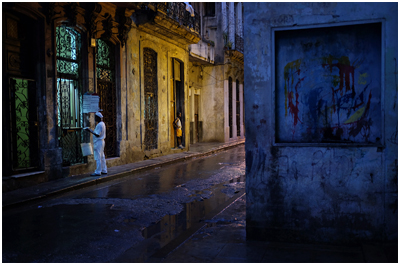
But since I set up this site to help people avoid many of the mistakes I made as a young photographer, you might as well consider this one: In your new-found enthusiasm for lighting, remember not to shoe-horn cool light into photos that might have been just as good (or better) shot in ambient.
Conversely, don't think you are done creatin a good photo just because you have set up nice light.
I say that because I always have a strong inclination to apply whatever trick I just learned on the next job that comes along. I doubt I am alone in this psychosis. In the photojournalism pecking order, content and moments trump cool light. If you are concentrating on light at the expense of the other two, you are short-changing yourself and your pictures.
Case in point: Yesterday, I walked into a court hearing for John Allen Muhammad, (the convicted killer in the Washington, D.C. "sniper" killings in 2002) armed with a strobe, a light stand, and umbrella and Pocket Wizards.
Granted, this is my normal set-up that I usually carry with camera gear into indoor settings. But still.
We were going to have the opportunity to shoot the major players in his second trial (Maryland jurisdiction this time) for the killings that happened in Maryland. Actually, I felt pretty smug when the light turned out to be about 1/20th of a sec at f/2.8 at ASA 1000. I just set that strobe up on a stand in the corner, put it on full manual into the white ceiling, popped on a Pocket Wizard and got ready to shoot at 1/125 at 2.8 at ASA 400.
Long story short, the lawyers became concerned at how Mr. Muhammad might react at the sudden site of nine video guys and an equal number of still shooters. It was a genuine media circus, and probably not too respectful of the jududicial process at that.
Upon sensing that the judge was a hairs breadth from kicking us all out, we quickly agreed to let the AP's Chris Gardner shoot - available light - as a single pool photog to preserve our chance of getting any photos at all.
We were lucky. It worked, and Chris and I spent the next hour burning CD's for everyone else of his whole shoot.
Back to the point, at some point during the day, Chris said, "Do you always carry a light stand around like that?"
"Well, yeah," I told him. It is nothing much to throw my little set up on my shoulder, so why not? As long as I can lug it, where's the downside?
Well, the downside is subtle and a little sneaky.
The downside is that you go in, planning to light. And because of your set-in-stone preconceptions, miss a found picture or moment. Why? Because you did not let the assignment develop more organically, for lack of a better word.
I look at light like this: The primary benefit of adding light is to raise the quality level on low-yield assignments. That's a no-brainer.
You could say the same for portraits, but it is not always the case. I try to think of strobe light as an option, along with all of the ambient sources at my disposal at the assignment. I walk in ready to use a strobe, a window, a desk light, a florescent, a sunbeam - whatever is there. Any or all of the above.
Just don't walk in with your lighting technique set in stone and ready to do. The gift of being open to serendipity is one of the best strengths a shooter can have, IMO. Be ready for cool stuff to happen. Keep your eyes open.
And if it doesn't, (or if it was never going to in the first place) think up some cool light and do it up right.
To a hammer, everything looks like a nail. That's the trap. Don't be a hammer. Adding light is a great option.
Just don't use it as the end-all. You still have to make a good photo -- whether you add light or not. And if you think that way, your lit photos will have more life, too.
Next: Keep a Lighting File
For example, I have to wonder what any motorists driving down a certain street in Romania a few days ago might have thought of the sight of a photographer - complete with off-camera flash on a stand - snapping away at a very well-lit tree. I am not making this up.
(I am thinking the reaction might have included whatever the Romanian word is for "drugs.")
And no, I am not making fun of the reader in question, either. Far from it. I think it is great. You get better by practicing, and I have seen an outpouring of genuine enthusiam on this site from day one that really makes me feel good about setting it up.
But since I set up this site to help people avoid many of the mistakes I made as a young photographer, you might as well consider this one: In your new-found enthusiasm for lighting, remember not to shoe-horn cool light into photos that might have been just as good (or better) shot in ambient.
Conversely, don't think you are done creatin a good photo just because you have set up nice light.
I say that because I always have a strong inclination to apply whatever trick I just learned on the next job that comes along. I doubt I am alone in this psychosis. In the photojournalism pecking order, content and moments trump cool light. If you are concentrating on light at the expense of the other two, you are short-changing yourself and your pictures.
Case in point: Yesterday, I walked into a court hearing for John Allen Muhammad, (the convicted killer in the Washington, D.C. "sniper" killings in 2002) armed with a strobe, a light stand, and umbrella and Pocket Wizards.
Granted, this is my normal set-up that I usually carry with camera gear into indoor settings. But still.
We were going to have the opportunity to shoot the major players in his second trial (Maryland jurisdiction this time) for the killings that happened in Maryland. Actually, I felt pretty smug when the light turned out to be about 1/20th of a sec at f/2.8 at ASA 1000. I just set that strobe up on a stand in the corner, put it on full manual into the white ceiling, popped on a Pocket Wizard and got ready to shoot at 1/125 at 2.8 at ASA 400.
Long story short, the lawyers became concerned at how Mr. Muhammad might react at the sudden site of nine video guys and an equal number of still shooters. It was a genuine media circus, and probably not too respectful of the jududicial process at that.
Upon sensing that the judge was a hairs breadth from kicking us all out, we quickly agreed to let the AP's Chris Gardner shoot - available light - as a single pool photog to preserve our chance of getting any photos at all.
We were lucky. It worked, and Chris and I spent the next hour burning CD's for everyone else of his whole shoot.
Back to the point, at some point during the day, Chris said, "Do you always carry a light stand around like that?"
"Well, yeah," I told him. It is nothing much to throw my little set up on my shoulder, so why not? As long as I can lug it, where's the downside?
Well, the downside is subtle and a little sneaky.
The downside is that you go in, planning to light. And because of your set-in-stone preconceptions, miss a found picture or moment. Why? Because you did not let the assignment develop more organically, for lack of a better word.
I look at light like this: The primary benefit of adding light is to raise the quality level on low-yield assignments. That's a no-brainer.
You could say the same for portraits, but it is not always the case. I try to think of strobe light as an option, along with all of the ambient sources at my disposal at the assignment. I walk in ready to use a strobe, a window, a desk light, a florescent, a sunbeam - whatever is there. Any or all of the above.
Just don't walk in with your lighting technique set in stone and ready to do. The gift of being open to serendipity is one of the best strengths a shooter can have, IMO. Be ready for cool stuff to happen. Keep your eyes open.
And if it doesn't, (or if it was never going to in the first place) think up some cool light and do it up right.
To a hammer, everything looks like a nail. That's the trap. Don't be a hammer. Adding light is a great option.
Just don't use it as the end-all. You still have to make a good photo -- whether you add light or not. And if you think that way, your lit photos will have more life, too.
Next: Keep a Lighting File
Follow me on Twitter: @Strobist
Now Shipping from USA and UK: Strobist Lighting Seminar DVDs
Feed your brain: My Favorite Lighting/Photo Books


9 Comments:
Once again another well done ...
Well said. If anyone is anything like me, I get very excited being in possession of a new lighting technique and am always itching to try it out on the next job but for me the most exciting thing is being safe in the knowledge that you have tons of ideas at your disposal. Walking into your job and talking to your subject(s) in a relaxed manner and winning their confidence is my number one priority. Once they're on your side you can hit them with any lighting set-up you fancy (not literally obviously).
thanks for the reminder, and a very timely one too.
Indeed, the whole purpose is to get great pics regardless of equipment or technique.
So often, we get caught up with all these new technologies and upgrading craze that we forgotten the basics.
Thanks again
Again, I truly appreciate your combination of competence and honest humility. It is a very rare combination in this digital world.
Thanks!
John
Fantastic read; I agree on all points as well. And thank you for all the enthusiasm you put into this website; as a beginner I have learned so much. And for free too! Hehe.
Strobist is the best thing since I discovered an obsession for photography...thanks a stack David! Starting out as a mature journalism student, in a changing media industry, I can't even say how much your casual wisdom helps me.
Thank you thank you. Here in South Africa, I hope to try out these techniques soon in the field. Already having great fun experimenting at home with your ideas.
Therese
It's fun to find an almost anti-strobist lighting post on strobist. It reminds me of when I was restricted to only on-camera flash and had to use a reflectors for non-ambient lit shots. Budget certainly turns every photographer into a lighting ninja :-)
Nicely put! And very very true! I'm just starting to take my flash off-camera and your articles are exactly what I needed.
Thanks!
PS: If you are still looking for that romanian word, it's "droguri" :)
but digital cameras have changed everything, from film to the way light moves through a lens. this post would be worth updating.
Post a Comment
<< Home