
Lighting 101: Cross Lighting
Abstract: Using just one light? Consider placing it opposite the sun.

Cross lighting is nothing more than using two light sources that oppose each other in their direction.
I say light sources, instead of strobes, because It is important to remember that if you are photographing outdoors with one strobe, you really have two lights. Rather than just trying to do damage control on what the sun is doing to your subject, start to think in terms of using the sunlight as your main (or secondary) light.
The photo above is of a fifth grader who, using herself as a human shield, saved this tree at her school when construction workers building a nearby parking lot were about to mistakenly bulldoze it.
She was a hero in the story. And I wanted to visualize her that way in the photo, so I shot up at her from a low angle. To get a clean background, the sun had to be coming from the upper-back-camera-right direction.
I could have very easily fill flashed her if I was just trying to undo bad sunlight. But if you are working with a small stand, it is just as easy to use your strobe more effectively.
I placed the strobe on manual (at 1/2 power) up on a stand coming from the upper-camera-left, and had her face the strobe. Exposure was 1/250th, of course, to make life easier on the flash, with the corresponding aperture to properly expose the sky.
Now, the strobe becomes the main light, and the sun becomes the rim light. Waaay better than on-camera fill flashing.
This cross lighting scheme is pretty forgiving with respect to subject movement, too. As long as you are working on the quarter angles (roughly splitting the difference between the two light sources) you are going to be fine.
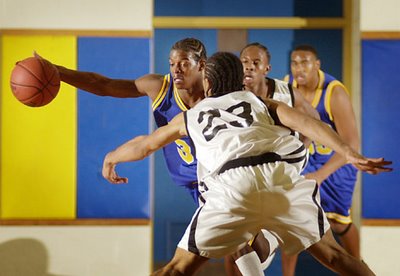
When I shoot high school basketball I like to cross light, too. I use two SB's, one at the top center of each set of bleachers, aimed in a cross pattern at the top of the key. Using them at 1/2 power with a 50mm throw will usually get you an honest, crisp-looking f/2.8 at ASA 800 from the mid-court line to the other basket.
It can be helpful to use external battery packs for these strobes, as you are gonna be firing off a lot of half-power frames. AA's get eaten up pretty quickly this way. Plus, you'll be waiting between shots.
Next: Lighting 101: Back Light as Main Light

Cross lighting is nothing more than using two light sources that oppose each other in their direction.
I say light sources, instead of strobes, because It is important to remember that if you are photographing outdoors with one strobe, you really have two lights. Rather than just trying to do damage control on what the sun is doing to your subject, start to think in terms of using the sunlight as your main (or secondary) light.
The photo above is of a fifth grader who, using herself as a human shield, saved this tree at her school when construction workers building a nearby parking lot were about to mistakenly bulldoze it.
She was a hero in the story. And I wanted to visualize her that way in the photo, so I shot up at her from a low angle. To get a clean background, the sun had to be coming from the upper-back-camera-right direction.
I could have very easily fill flashed her if I was just trying to undo bad sunlight. But if you are working with a small stand, it is just as easy to use your strobe more effectively.
I placed the strobe on manual (at 1/2 power) up on a stand coming from the upper-camera-left, and had her face the strobe. Exposure was 1/250th, of course, to make life easier on the flash, with the corresponding aperture to properly expose the sky.
Now, the strobe becomes the main light, and the sun becomes the rim light. Waaay better than on-camera fill flashing.
This cross lighting scheme is pretty forgiving with respect to subject movement, too. As long as you are working on the quarter angles (roughly splitting the difference between the two light sources) you are going to be fine.
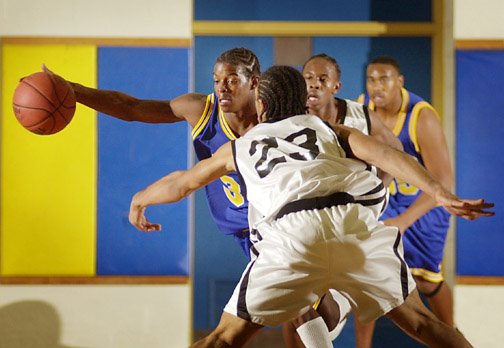
When I shoot high school basketball I like to cross light, too. I use two SB's, one at the top center of each set of bleachers, aimed in a cross pattern at the top of the key. Using them at 1/2 power with a 50mm throw will usually get you an honest, crisp-looking f/2.8 at ASA 800 from the mid-court line to the other basket.
It can be helpful to use external battery packs for these strobes, as you are gonna be firing off a lot of half-power frames. AA's get eaten up pretty quickly this way. Plus, you'll be waiting between shots.
Next: Lighting 101: Back Light as Main Light
__________
New to Strobist? Start here | Or jump right to Lighting 101
Now available in audiobook: The Traveling Photograher's Manifesto
Permalink


<< Home