Lighting 101: Cereal Box Snoots and GoBo's
Now that you are getting comfortable with the idea of shooting a light into an umbrella or ceiling, creating the lighting ratio and being color correct, it is time to start stretching a little.
Sometimes what makes a photo sing is not so much where the light is, but where it isn't. And, given that you already have a basic, off-camera strobe setup, you can make the gear you will need to restrict light for just a few pennies.
Remember when we put the Velcro on the sides of your flash head? It holds gels fine, but you should also add another piece of (loop side) Velcro so you can fasten a GoBo to your light.
("GoBo" is slang for something that goes between your light and something you do not want it to hit.)
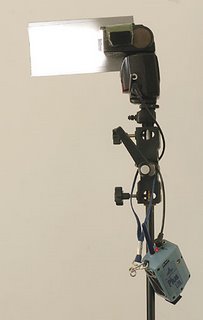
To make a useful-sized GoBo, Cut a piece of still cardboard to make a rectangle about 4x8 inches. Cover it with gaffer's tape and stick some Velcro (the "hooks" side) at one end and at about a third of the way from the other end. This will allow you to attach it to the side of your flash either way so that you can choose how far it sticks out.
While I am thinking about it, you'll want to get a small roll of gaffer's tape. Looks like duct tape, but it is not. This stuff is light-tight, leaves no residue (unless you leave it on for about 6 months) and is indispensable to have in your trunk/light bag.
Back to the GoBo.
Now, you have a sort of "barn door" that can block the light from your flash in the direction that you choose.
Say you are using your flash to side/backlight something. Your flash, being small and not-too-powerful, is just out of the camera frame. The GoBo could be stuck on the side of the strobe closest to you to keep light from flaring into your lens.
You can also use one on each side of the flash to make light that spreads vertically, but not horizontally (or vice versa.) You can keep light off of a background this way, as you may be lighting it from another source.
If you are going to make one of these, you may as well blow a whole quarters worth of Velcro and make four or six of them. They just slide into the lid or back pocket of a Domke bag and weigh almost nothing. No brainer.
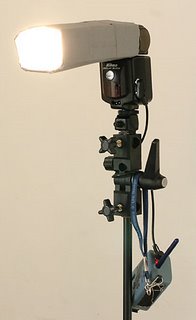
If you want to restrict the light even more, you'll want a snoot. It is nothing more than a sort of tunnel for the light to go through that will restrict it is all directions except for the exact direction the strobe is pointed.
Just shape the cardboard into a rectangular-shaped tube that will slide over your flash head. Make a few - 6", 8", 12" - the longer the tube, the tighter the beam of light. Now cover it in gaffer's tape to make it more durable and light-tight.
(By the way, when you shoot with a snoot, set your flash on its most telephoto setting. No sense in wasting power by sending a wide beam of light just to block it with a snoot.)
How do you know how big your spot will be? Pop it against a wall from a good working distance (say, 5 feet) to get an idea of the beam spread of the various tubes. You might want to write your results on the tubes themselves, as in "1x2-foot pattern at 5 feet," etc.
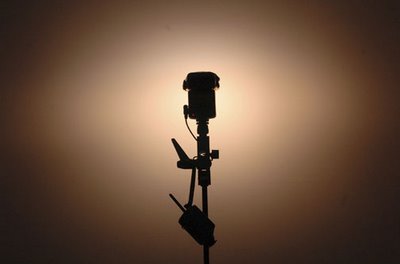
This is a flash fired against the wall (4 feet away) at the "85mm" zoom setting. Note the pattern of the light.
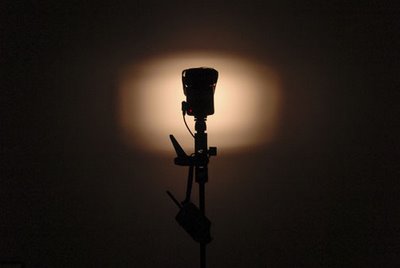
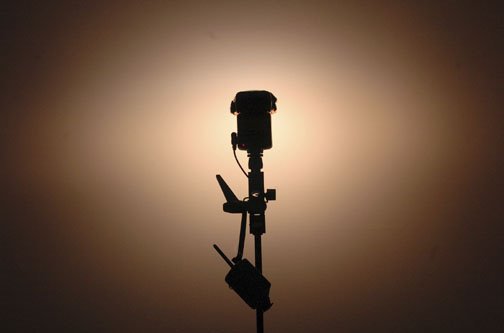
This is the same setup, with an 8" cardboard snoot on the flash.
Now, how are you gonna work like this without modeling lights? I'll tell you.
You don't need no stinkin' modeling lights.
Here's your modeling light:
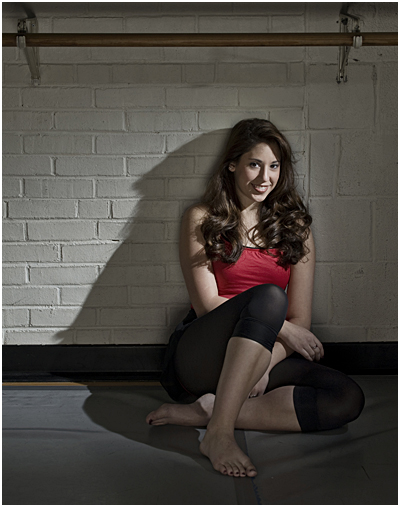
You ask your subject, "Can you see the front of my flash through the tube from where you are sitting?" If they can, the light will be falling on their face.
You know that cool shaft of light you like to exploit when you see it coming from a window or something? Now you can make it any time.
This is a very useful style of light for cool portraits, but you have to be aware of your ambient level. Crank up the shutter speed for more drama, or open it up for more detail in the unlit areas.
For many beginners, this is a new technique that will open up loads of possibilities. Spend an evening experimenting with it at home to start to understand what it can do.
Next: Textural Lighting for Detail Shots
Sometimes what makes a photo sing is not so much where the light is, but where it isn't. And, given that you already have a basic, off-camera strobe setup, you can make the gear you will need to restrict light for just a few pennies.
Remember when we put the Velcro on the sides of your flash head? It holds gels fine, but you should also add another piece of (loop side) Velcro so you can fasten a GoBo to your light.
("GoBo" is slang for something that goes between your light and something you do not want it to hit.)
To make a useful-sized GoBo, Cut a piece of still cardboard to make a rectangle about 4x8 inches. Cover it with gaffer's tape and stick some Velcro (the "hooks" side) at one end and at about a third of the way from the other end. This will allow you to attach it to the side of your flash either way so that you can choose how far it sticks out.While I am thinking about it, you'll want to get a small roll of gaffer's tape. Looks like duct tape, but it is not. This stuff is light-tight, leaves no residue (unless you leave it on for about 6 months) and is indispensable to have in your trunk/light bag.
Back to the GoBo.
Now, you have a sort of "barn door" that can block the light from your flash in the direction that you choose.
Say you are using your flash to side/backlight something. Your flash, being small and not-too-powerful, is just out of the camera frame. The GoBo could be stuck on the side of the strobe closest to you to keep light from flaring into your lens.
You can also use one on each side of the flash to make light that spreads vertically, but not horizontally (or vice versa.) You can keep light off of a background this way, as you may be lighting it from another source.
If you are going to make one of these, you may as well blow a whole quarters worth of Velcro and make four or six of them. They just slide into the lid or back pocket of a Domke bag and weigh almost nothing. No brainer.
If you want to restrict the light even more, you'll want a snoot. It is nothing more than a sort of tunnel for the light to go through that will restrict it is all directions except for the exact direction the strobe is pointed. Just shape the cardboard into a rectangular-shaped tube that will slide over your flash head. Make a few - 6", 8", 12" - the longer the tube, the tighter the beam of light. Now cover it in gaffer's tape to make it more durable and light-tight.
(By the way, when you shoot with a snoot, set your flash on its most telephoto setting. No sense in wasting power by sending a wide beam of light just to block it with a snoot.)
How do you know how big your spot will be? Pop it against a wall from a good working distance (say, 5 feet) to get an idea of the beam spread of the various tubes. You might want to write your results on the tubes themselves, as in "1x2-foot pattern at 5 feet," etc.
This is a flash fired against the wall (4 feet away) at the "85mm" zoom setting. Note the pattern of the light.
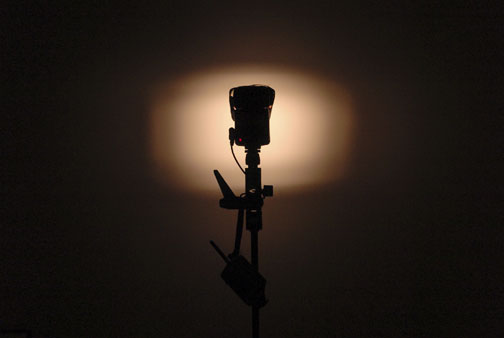
This is the same setup, with an 8" cardboard snoot on the flash.Now, how are you gonna work like this without modeling lights? I'll tell you.
You don't need no stinkin' modeling lights.
Here's your modeling light:
You ask your subject, "Can you see the front of my flash through the tube from where you are sitting?" If they can, the light will be falling on their face.
You know that cool shaft of light you like to exploit when you see it coming from a window or something? Now you can make it any time.
This is a very useful style of light for cool portraits, but you have to be aware of your ambient level. Crank up the shutter speed for more drama, or open it up for more detail in the unlit areas.
For many beginners, this is a new technique that will open up loads of possibilities. Spend an evening experimenting with it at home to start to understand what it can do.
Next: Textural Lighting for Detail Shots
Labels: DIY


42 Comments:
For those who are morally opposed to cereal boxes and gaffer tape, there's a LumiQuest snoot that brings plastic and money to the party. Personally, I think it's worth getting out with the gaffer tape.
Besides, going the cereal box/gaffer tape route gives you endless discussion topics. Is black gaffer tape better than silver? Is flat black better than shiny black? Which cereal box delivers the best light? Of course, for the Rolls-Royce of snoots, you need to use silver tape on one side, black on the other and choose the most expensive and obscure imported cereal you can find.
I'm going to lie down, now!
i've made three cardboard snoots for my sunpak 383. then i printed out small 2inch prints of my test shots and pasted them on the cardboard. now all i need to do is look at the pasted photo to see how much light the snoot throws out.
- rench (philippines)
Is gaffer's tape really necessary? As far as I can tell, the main advantage is that it leaves less residue behind. Given that I'm unlikely to peel it off of the (expensive imported) cereal box, can I really justify the increased expense. I'd love to hear a justification, but for now I think I'll stick with duct tape.
Gaffer's tape is opaque and very strong. I am not a fan of spending money unnecessarily (unless a cool new XM receiver is involved...) but this stuff is so useful, I really do not know what I would do without it.
The fact that it does not leave a residue means you can use it almost anywhere. I make all kinds of stuff out of it on the fly as I need it.
Because of the lack of residue (it peels off and tears easily, too) you can even keep spare pieces on gear (like tripod legs) for when you need it.
Where, in the Columbia MD area, can you find gaffer or Permacel 665 tape? Home Depot and Ace Hardware looked at me like deer caught in headlights?
Service Photo has it, up in B-more.
-D
I've made a pretty sweet little snoot out of a pringles can that would pressure mount onto vivitar 385s. you just use a can opener to open the closed end so both are open... inside is silver and a little bit of matte black spray paint on the outside makes it look like an "official" piece of gear :)
i really like using it for a hair/accent light from a stand or clamp about 8-10ft high at a 45 behind the subject...
Philip
lithiumpicnic.com
you can add the milky omin-bouncey cap for different effect...
Being incredibly lazy, I immediately went to my pantry after reading this article and discovered that a Jiffy Corn Muffin Mix box fits perfectly on my Sunpak PZ5000. No measuring, no unpleasant bending, just cut off the flaps, put gaffer's tape on the outside and you're all set. Three strips of 2" gaffer's tape covers the box perfectly to give a 6" snoot. Need an 8" or 12" snoot? Just cut some cardboard to make splices and glue them in place on the inside of two boxes, then wrap with gaffer's tape as usual. Voila!
Now I'm getting hungry...
Any recommendations for an online source of gaffer's tape? (Living in rural NC doesn't give me many local options.)
Thanks much!
Jim
Adorama has it in just about any form you could want. Clicking on the banner at top gets you to their main site.
To make a useful-sized GoBo, Cut a piece of still "STIFF?" cardboard to make a rectangle about 4x8 inches.
Another piece of plastic that will not be going to the landfill. First, go through your refridgerator for a ketchup/mustard/pizza sauce squeezable bottle with a bottom that is the same size as your flash head, and the top is tapered to a round opening. Once you have emptied the contents, place the bottle in boiling water to remove the label. Don't worry if the bottle collapses from the heat...just fill it up with hot water to restore the shape, and let it cool in a sink full of ice. Cut off the top and bottom, (the bottom of my pizza bottle was almost the same size as the SB-24 head), then "warm it up" over the stove, (use an oven mitt so you won't burn your hand...trust me on this one) and place it on the SB-24...yes, it will stretch. I used left-over black plastic furniture spray paint for the outside, and left-over aluminum tape from the dryer hose in the laundry room on the inside. For location shooting, I take the snoot, slip it over my umbrella, and place it together with my lightstand (aka: tripod)in a nylon case that you get for free if you buy a folding camping chair at Wal-Mart for under $8. You can use the left-over chair to relax and marvel at your accomplishment.
Why would you Buy a Snoot when you can make a simply effective one from a Cereal box? Plus, not only do you save $$, you get that "hey, I made this myself" feeling and the best part? Eating the Captain Crunch to get to the empty box!!
Yumm, the best tasting piece of equipment you'll ever own! HA! Beat that Lumiquest...I dare ya!
Zacker.
I've made quite a few foamcore snoots as a film grip. The stuff is stiff, looks professional (it is) and is pretty cheap at art stores (avoid offices stores).
Figure out the dimesnsions of your flash unit (i.e. the top and bottom on my SB-28 is 2.5 inches and the sides are 1.5 inches (2.5 + 2.5 + 1.5 + 1.5 = 8"). So, cut a piece of foamcore however long (6", 8", 12"), by 8" -- the dimention of the flash head (with a little extra to fit around the unit).
Take the cut piece and with straight edge and knife score the foamcore lengthwise. Then, bend the pieces along the score marks and fold the snoot together. Tape the two sides to hold it, add your velcro and you're done.
You can buy foamcore black on one side, white on the other which is super good for bounce cards, negative and making flags to keep the flash off the background.
i am using the foam paper for the snoot...and connecting the cone with a long strip of hook&loop this allows me to change the size of the snoot to the situation
To save some work and perhaps some space in your bag, how about a telescoping snoot by having one section slide over another? since your probably fashioning it yourself to begin with it seems this wouldn't require much extra work and would eliminate the need for multiple snoots of different lengths, as well as the effort of changing snoots to fine tune the effect.
What is that blue thing connected to the flash?
What is that blue thing connected to flash and dangling on the air?
for the smaller headed nikon SB's, like the sb80Dx(and 28dx? 600,800?), ive found a spaghetti box fits perfect without any trimming. just slide on, tape and trim to desired length. the sb25 (and 24?) has a larger head, so that doesnt work.
Not having a local source for gaffer tape yet wanting to get started on snoots and gobo's, and being a Canadian, I resorted to black hockey tape. Works fine. However, I did order some gaffer tape from Mpex when I ordered up my lighting kits.
-Scott.
Like the Jiffy Corn Bread Mix box and a spaghetti box, a Kraft Mac & Cheese box also works quite well and fits comfortably over the head of both a SB-26 (quite snug) and a SB-800 (a little looser but still stays on) without any additional modifications.
I don't have gaffer tape available so duct tape is a reasonable substitute.
Note that boxes from other brands of mac and cheese may also work but they're not as cheesy as the Kraft brand boxes.
The $1.36 snoot you can buy anywhere.
1. Purchase a large coke, pepsi, Mtn. Dew over sugared beverage of choice from Mc.Donalds.
2. Drink it as fast a possible (note the brainfreeze.)
3. Dry the inside.
4. Take 1 SB-24 and push it hotshoe first through the bottom of the cup (requires aid in the ripping out of the bottom).
5. Stop pushing when the head of the flash fits snuggly in the bottom of the cup.
6. Take a magic marker (MC.Ds may be happy to provide if you're full of smiles) and color that thing black, blue or tint of your choice.
7. Snoot away! Need a diffuser?! Pop on the traslucent plastic drink cover and BAM! Good to go.
Thanks fast food.
Great site, I have gotten loads of good information, thank you for taking all the time to publish your ideas. Just to let you know I found another solution to the cardboard. I thought of this after someone mentioned the Pringles container with the foil finish. I just made the GoBo's and snoots out of silver mat board. You can get a 30 by 40 inch sheet for less than $7.00. Since I have a mat cutter this made the job very easy. In fact, I made the two special designs from your Lacross player #2 story. I will be using some translucent heavy mylar for my design instead of the typing paper. Keep up the great work.
NEWBIE posting!!!! Great site! I read alot about GAFF tape..I work in the Film and Television business, and we use PAPER tape. It's less "sticky" taape. It does not leave a residue either. It's actually less expensive than GAff tape. Just my 2 cents...thanks BK
Cammy said...
Where, in the Columbia MD area, can you find gaffer or Permacel 665 tape? Home Depot and Ace Hardware looked at me like deer caught in headlights?
Penn Camera in Laurel and Rockville have it. It is certainly pricey, but I do re-use it frequently . I've got strips on my camera and tripod that get used for holding cords when needed.
-Mickey in Eldersburg, MD
The pringles tin snoot works for me,it pressure fits my SB26 like a glove.Everyone ready for 102?
tommysdad
a note about using a snoot on an sb-800:
David mentioned setting your zoom at max (105mm on sb-800) when using a snoot... however, there is a little micro-switch on the 800 that when anything is attached to the head of the flash (such as an omni diffuser) will automatically change the zoom to 14mm... even on manual mode.
any thoughts on defeating this?
maybe taping in a couple little 'bumps' on the inside of the snoot to bridge over the switch???
Re: gaffer tape
I use it constantly. On fashion & advertising shoots, there is always a roll of matte black gaff lying around. Gaffer tape is stronger than paper tape. Not as strong as duct tape, but easier to peel off and reposition. I've found that the tape residue become a problem after about two months, not six. A good trick for removing the residue if you've left it on for too long is to peel off a fresh piece and use the sticky side to lift up the residue off of any hard plastic or metal surface. High humidity renders gaffer tape nearly useless, so be careful. I use a small strip of it to fasten the bayonet mounting UV filter to my Hasselblad lens; when it gets to the dog days of summer (like now), I have to be extra careful not to twist off the filter with the lens cap.
A very cheap mylar can be had in the wal-mart party goods section. I am able to buy a 20 foot happy birthday banner, one sided printing, for $1.89. A glue stick later and I've silver coated the required Go-Bo gear , and still have yards available for little table top reflectors and such.
Thanks for all the good info; I'm enamored with this constructive and helpful community.
Johny M.
I proudly made my snoot from a Shredded Wheat (UK) a couple of nights before my weekend shoot, and used it for the first time as a side fill light. What I wasn't prepared for was the flash of golden/yellow light from the snoot: the packet is bright yellow - my model just smiled and said "Cheerios would have been better"..
Maybe I'm a snob. I wanted a bit more than cardboard so I went to the sewing store and came up with my own snoot. Wasn't bad, about $10 of materials if I was going to make it again. (that means I bought way too much material :P) It is adjustable from a wide to narrow snoot. Enjoy.
My Custom Snoot
You can narrow the beam of light further by using cardboard inserts/gobos. I've posted pics on Flickr of the one's I use.
http://www.flickr.com/photos/rpearson/2091652347/
And for some more cool snoots...go to Home Depot and look in the Wet/Dry Vacuum section in the bins and get one of the little adapters that even LOOKS like a round snoot! Costs $10.00 (ouch - almost defeats the purpose!); but what a snoot! On the big round side, cut out two "sides" so it will fit your flash. I used double sided velcro wrapped around the remaining sides to hold it on the flash! You could even cut the little round sections and use the ones you want for different hole sizes by shoving them into each other! And it looks pretty darn good, too!! Fits Nikon SB-26, 28, 800, and whatever else probably.
And for those who don't like tape on your cardboard snoots, look in the Arts & Crafts store for those thin rubbery sheets that have a paper you peel off the back (there is stickiness under the paper you peel). Then cover your glorious other snoots and diffusers with the rubber sheets that you have custom cut to fit. Makes your device look almost professional!! Feels good, too! Sheets cost all of less than a dollar.
For a look at what I am talking about come to my gallery page of these snoots and a neat big diffuser - all home-made. Go here - http://www.southeasternphotography.com/gallery/3987571
I gave credit to this blog for my inspiration!
Troup
troup@rocketmail.com
Another tip for you folks (self included) who do not like or want to stick velcro to the sides of your flash for those few times you need to "stick" one of your home-made or store-bought snoots, diffusers and other accessories to the flash.
Get the ready made double sided velcro rolls - mesh on one side and the hooks on the other side. Simply wrap this around the flash head when you need it - it "velcroes" (new verb!!) to itself. Then just have the correct velcro strip on your accessory to stick to your flash. When finished, you simply remove the double -sided velcro, roll it up and stick it back in your bag. This stuff is also a super way to tie your accessories or camera to various odd objects - trees, rails, tripod legs, cow's leg (don't ask), etc. No muss no fuss or gooey residue to clean off anything! And it won't rip off in the wind like gaffers tape or other tapes. And you can leave this attached for more than 6 months and still no residue!! hahah attack on gaffers tape!
And for you real DIYers, make your own double sided velcro - add one part mesh to one part hook as long as you like. Amazing the folks who told me they never thought of doing that!! Huh?!
BTW, our Arts and Crafts store call "Michaels" ( a chain) has poster board 19.5" by 26" in a brand called "CHROMOLUX". You can get the silver chrome one which reflects light like a mirror, an off-white (warmer reflectivity), or even a gold one for that golden glow reflection. Prices range from $3+ to $4+ each. They cut well, have good bending characteristics, tacky glue down superbly, and add a touch of class to your DIY snoots and reflectors! (No, I don't work there or anything!) I've started building more of these DYI accessories and my wife keeps asking me whenever will I use these things...I tell her, I don't know, but don't they look great!!!
Troup Nightingale
troup@rocketmail.com
Viewfinder have just unveiled a new range of Nikon/Canon fit speedlite modifiers including much more professional lookling snoots!
I've put the pics on my blog...
http://www.jmphotographer.com/blog/2008/01/swpp-bppa-convention-2008.html
You know what else holds stuff to your camera and leaves no residue? Rubber bands.
From what I see that sounds more like a cookie rather than a gobo, which I'm pretty sure stands for Goes Before Optics, cause Gobos are used in lighting fixtures that can focus the light, check out this website for gobos
http://www.stagespot.com/gobo.html It's the the thing you project with you name on it for weddings and stuff like that. Just saw they sell Gaffers tape too, plus they ship it for free! here is that link
http://www.stagespot.com/tape.html
Just spent a chilled day measuring n making my own snoot out of cardboard then ate a packet of pringles and found it fits perfect onto my speedlite...
Newbie here. I stumbled onto a snoot possibility the other day...I finished using the last little tub in a canister of Crystal Light and realized that it could possibly fit the end of my flash. Tore the label off, popped off the lid, and squeezed the canister opening into an oblong shape and...presto! I have a sweet new light diffuser snoot for my Canon 430EX! I'm looking at buying a can of black plastic spray paint to coat the outside and will figure out how to lop off the other end. Hope this helps someone!
Nice post! I tried this with black paper to try to absorb more of the light. Worked nicely! By the way, is that a generic PW? I'm trying to find more economical transmitters.
heh heh heh...
( rubbing hands together ; )
dig...
The Microsnoot:
http://blog.nikonians.org/martin_joergensen/2008/07/a-minisnoot.html
( this is for them of us who wanna make one right )
Froogle: Black Straws
The post on the definition of Gobo above is correct. Gobo refers to a device placed between lenses of a lantern which may be focused. It is usually made from glass or aluminium and serves to project a pattern which is cut or etched into it.
These devices described here would be (as stated) more correctly referred to as "barn doors" or shutters.
Post a Comment
<< Home