For a Few Dollars More: The Nikon SB-26
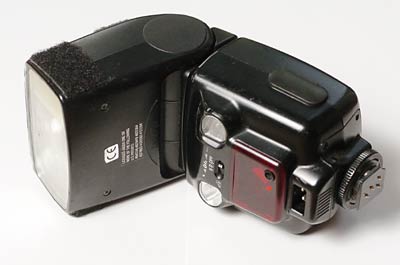
Anyone who has been reading Strobist for a while knows that I think the Nikon SB-24 is the best bet for the starving student's entré into the world of off-camera manual flash. With an external PC connection and full manual control over a 5-stop range, it has what you need without your paying for what you don't.But for someone with a little flexibility in their budget, the more recent (circa mid-90's) SB-26 may be a better call. And if you are moving from just one flash to two, the SB-26 is a no-brainer. It can be had for around $100 at the time of this writing.
NOTE: If the earlier readers swoop in and snarf up the sub-$100 examples, don't blame me. Well, OK, I guess technically you could blame me, but they were just faster on the draw. So try to wait for more stock or troll eBay for a while to grab a good deal. But bear in mind that you are likely to be bidding against each other for the few days after May 15th, when this post goes up.
The SB-26 does everything the SB-24 does, plus the following:
• Full manual control over a 7 f/stop range.
• A built-in bounce card.
• A built-in diffuser panel for ultra-wide beam width.
• A "delay" function (more on that later.)
• A built-in optical slave. (Schwing!)
Now, before I go into detail on the features, I want to give you a word or two about keeping these vintage flashes alive.
First, USE THEM OFF CAMERA. I'm not making a value judgement (for once) on your lighting skills. It's just that the hot-shoe foot is the vulnerable point on these flashes. An SB-24, or -26, or whatever, could theoretically last you a whole career if it is happily firing on a stationary stand. That's because there is no torque on the hot shoe foot.
But if you are shooting on-camera, say, stalking Sean Penn or English soccer hooligans, well, that's another kettle of fish. You might catch an elbow (or a brick) to the head and your flash foot could go 'bye-bye' real fast.
Even if you use them on stands, a good policy is to not stick them straight out so all of the pressure is on a horizontally-mounted shoe foot. Mount them vertically (or as near to vertical as is practical) and use the swivel head to do the pointing. Way less torque. Way happier flash foot.
That said, if you snap one off, all is not lost. There is a good discussion (and link resources) for getting it fixed (even DIY-style) over at Sportsshooter. (Link will open in a new window directly to the discussion.)
Now, back to our regularly scheduled programming.
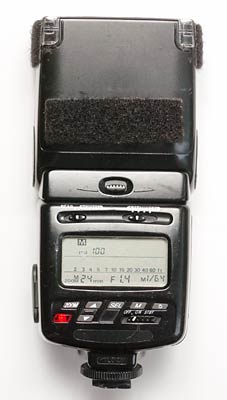
The seven f/stop range is really sweet, especially for close-up work. There are times when I have had to dumb that down even a couple more stops with neutral density filters. One-sixteenth power can be way too much at a few inches in distance.The "delay" mode is, as far as I know, unique to this model of flash. Here's how it works. Say you are using an on-camera flash in the auto (or TTL) mode. You can use the SB-26 in manual mode stuck out in the background somewhere as a back/rim/whatever light and it will wait until the other flash has finished firing before it fires.
Why is this important? Because if it fired at the same time, it could screw up the other flash trying to work in its auto or TTL mode. (Usually this means the main light would not put out enough light. That's bad.)
How does it know when the flash is done? It doesn't. There is simply a "delay" switch on front of the flash. (Set it to "d.")
Does it matter what kind/brand of camera/flash is used for the auto/TTL front light? Nope. (Sweet, huh?)
What does this cost me? Well, other than a few bucks more to get this flash instead of an SB-24 (or -25) it costs you a third of a stop on your max synch speed. Most SB/Nikon combos max out at a 250th synch. This setting limits you to 1/200th, to account for the delay. Not an issue in the environments where you are likely to need to be filling dark backgrounds.
Now, for the other feature that makes this an ideal second light: Built-in optical slave. It'll see your other flash fire and fire the SB-26, either in "real time" or in the delay mode. For our purposes, it'll usually be real-time.
Now, this is not a fantastic slave. But for typical environmental portrait set-ups, for instance, it works great. You can help it along by making the SB-26 the strobe that fires the weaker light of the two, if there is a difference. Theory is, if one flash is going to set off the other (using light) you want the slaved flash to be receiving the bigger shot of light - not the other way around.
The other way to increase your efficiency is to point the front panel (that's where the slave eye is) of the SB-26 at the other light. Since the head rotates and tilts, this is almost never a problem. And of the SB-26 is firing into an umbrella, you're golden. That umbrella acts as a big relector, catching your main light and sending it right into the sensor.
These babies sold for $350 (and adjust that for ten years of inflation) back in the day. And now people have visions of "$B-800's" dancing in their heads, so they sell them for a song. Why, thank you, Mr. Rich Photo Hobbyist Guy.
All in all, a great little light. And believe me, if I was still looking to pick up a couple more of them, you would not be reading this article yet.


23 Comments:
Since I'm still getting the hang of all this--AND because I'm a Canon user--answer me this: Could I use my Canon flash as the master to trigger an SB-26 as a slave? What if I have the Canon flash set to slave to use it with my Canon wireless transmitter?
i have a question. Does the SB 28 have a built in slave mode? I'm not really sure but from what I've read, it doesn't. Am I wrong? Im asking because a guy is offering his 2-year-old SB 28 for $100.
¿Does the SB 28 have a built in slave?
nope
Aaron-
Yes on the first part. Dunno on the second. The xmitter might set it off. Either way, the delay should get you past the first flash's firing. I would google around for someone else who has used this combo before committing money, tho.
Thank you for the remarks on broken hotshoes, I have a SB-28 which has a split shoe and I'm now getting excited about the prospect of having it repaired cheaply.
Someone is selling a brand new one
http://www.fredmiranda.com/forum/topic/397797
From what I've gathered this SB-26 is unique in this optical slave feature.
Am I missing something?
Mike
Sorry, misunderstood David's note on the SB28.
Picked up 3 of these locally for $80 CAD each today. They all work fine and have their bounce cards/diffusors in tact.
Oddly enough I had just finished doing my homework in trying to pick up a portable lighting kit and decided that the SB-26 was the one for me. I was worried when I saw the post about how great they were. Then I lucked into all I'll ever need in one stop.
Some notes from my brief experimenting. I am using a Nikon D70. The SB-26's don't fire even in delay mode if you are trying to use the on camera flash as the trigger if it is any of the Commander modes (TTL, M, AA). Which means using it wirelessly with my SB-600 is out because it dosen't have an optical slave mode.
That said it works fine with the on camera flash set to TTL and the SB-26's set to delay. It also works if you set the D70 to Manual flash (and the SB-26's to "s" or delay) 1/16th so it won't contribute to the exposure but it will still trigger.
How about that for a cheap completely portable lighting setup. ANd I still have my SB-600 for when I need the speed of i-TTL.
Chris Sweet
SB-26's are great lights. Especially for 2nd and 3rd lights in a setup. Just stick 'em on a stand, let the AA's power them and point the front body of the flash toward your main light.
When you consider you can snag these for $50-$60 pretty regularly, you start to salivate over the pictures you could make with $250 worth of lighting gear - total.
-DH
Thank you for the Sportsshooter link. The only Nikon repair guy in Alabama retired recently, and don't you know I snapped the foot off my SB-28 for the ten-thousandth time? He used to joke that he kept a box of feet just for me. Used to charge me $25, which wasn't bad, but now I feel pretty good about doing it myself. My other alternative was to have to send it to Atlanta or to Nikon, and who knows how long that would take.
I'm coming in on this a bit late... Hope somebody can advise:
Love the Strobist but I'm currently still in the "sort-of-high-end-point-and-shoot" stage -- a.k.a. no hot-shoe on the camera (Canon Powershot A80) and not currently in a position to start over w/ a DSLR.
I was considering getting an external flash and using it in slave mode. The problem is that the A80 fires a pre-flash which (I assume) will set off the slave too early.
Canon sells an external slave flash (HF-DC1) designed for the Powershot series which is pretty basic (hi, med, low) and costs about $100. From what I've read, the main advantage of this particular flash is that it waits until after the pre-flash to fire (to sync with the main flash).
My question (finally) is: will the SB26 -- slaved and set to "delay" -- do essentially the same thing (wait until after the pre-flash)? Does anyone have experience with this type of setup?
It would be a no-brainer to get a far better flash for about the same $$ (with room to grow)... *if* it will work in my current setup. Otherwise I may end up throwing more $$ at the A80... Which I'd rather not do...
Anyone?
Unless the flash has a special pre-flash mode (as some new optical slaves has, but not the SB-26) it will fire on the first pre flash. I haven't actually tried with the SB-26 but I'm confident it will not work.
If your camera is able to send out single flash (manual mode?) it will work fine.
Peter
So do I understand that I cannot use the SB-26 in slave delay mode with the SB-600 off camera in i-TTL mode and D70? Is that correct? I would like to use the D70 on-site flash to fire the SB-600 and the SB-26's. Will this work? Thanks for you help.
You can use the SB-26 with Nikon iTTL, but you have to make sure that the iTTL pre-flashes don't trigger the SB-26, which then will not have sufficient time to recharge and fire again with the main flash.
The way to do this is by using the FV-lock feature to trigger the pre-flashes in advance of the exposure and lock in the flash exposure level. Check the D50/70/80/200 manual for how to use FV-lock (which is also a very good feature to use for lots of other reasons). After triggering the FV-lock (normally by assigning the FV-lock function to the AE-L/AF-L or FUNC button), wait for the SB-26 to recycle (if it fired) and then make your normal exposure. The SB-26 will fire with the main exposure then (in S or D mode).
FV-lock is also very good because it locks in the exposure level (until the FV-lock button is hit again), and you can adjust the exposure compensation (general or flash exposure compensation) if the exposure was too high or low; the FV-locked compensation remains as the "base" for the adjustment.
Does anyone know if the auto focus illuminator on the SB 26 can be switched on (via the control panel or something simple on the hot shoe contacts) ... Versus requiring some communication from a Nikon camera?
A friend interesting in some portable lighting has a camera with poor low-light focusing, and no convenient manual focus. We're speculating that the AF from the SB 26 might be useful, if we can get it on and pointed towards the target.
Thanks,
Alan
Does any of you have any more experiences with a d70(s) sb-26s? what Chris said left me in a bit of confusion. thanks
Joseph
I've just bought an SB-26 for my nikon D70 and tried to use FV-lock trick from 'anonymous'. It seems to work: strobe trigger fine on the principal flash, but still no good results, maybe it's due to flash orientation, don't know...I'll tell you better after some tests.
OK, so here is the answer to my Q on the sb-24 page (couldn't find this page apart from via google) -- so just ignore that, please.
just for info for other Canon shooters, here is my set up: sigma ef 500 dg super on my canon 20D and the sb-26 as an optical slave -- works wonderfully (also (sort of) works when the sigma sends out a preflash and the sb-26 is on "D"elay ... but for some reason it only works if the flashes are over 6ft apart, which is curious, but I need to play around a bit more to figure out what is going on)
I have to say, again, the sb-26 is a really lovely little flash
can anyone clarify me if the sb600 has the same "built-in optical slave." or if it could be used in a similar manner as a slave since i don't have a nikon camera but i do have an oportunity to get the sb600 ? please ,if anyone can reply ...
HOW do I activete the ligt slave in sb26?!
using a D80 with internal flash or sb-400
Thank you!!
Set the front selector switch to "S".
just purchased one for 64 dollars cant wait for the ups guy to get here!
Post a Comment
<< Home