Strobist is an online project that was published from 2006 to 2021 by former
Baltimore Sun photojournalist David Hobby.
Available here as a completed archive it remains
world's most comprehensive source for photographic lighting education.
New to lighting? Welcome. Start with Lighting 101, linked below, as millions of other photographers have done before you. Or scroll down further to access Strobist's other free courses.
 Lighting 101
 is the core foundation of Strobist. It is a free, start-from-zero tutorial that will teach you the basics of lighting and minimalist lighting gear. Lighting 101 will have you up and running in no time—and at minimal expense.
Lighting 102 is the sequel to Lighting 101. Where L101 was about gear and basic concepts, L102 will teach you how to further understand and control the qualities of your light to make it do your bidding.
Lighting 103 is a deep dive into color. It explores the intersection of light and color to help you give your photos more nuance, realism and depth.
Strobist Lighting Cookbook combines the concepts learned in L101-103 to give you more understanding and fluidity with your lighting. We also explore some of the shoots from a 360-degree/ecosystem perspective.
A Baker's Dozen: Here you'll find a sampling of posts to help you understand the scope of the lighting education on this site.
From Classroom to Real World: On Assignment
 On Assignment
 features full walk-throughs of over 170 real-world assignments, complete with discussions ranging from lighting to concept to execution—and even some screw-ups.
It (largely) follows my path as a newspaper shooter and beyond, progressing from simple speedlights to more complex studio flashes.

Sad fact: There are a lot of companies that make some pretty crappy lighting gear, but are still happy to take your money. The
Strobist Gear Guide is designed to help you avoid making many of the costly rookie mistakes I made over the first few years of my career.
This is the gear that works for me, day in and day out. It is solid, reliable and will get the job done without destroying your wallet.

Books are gear for your brain. Chosen wisely, they represent some of the best value for dollar you can spend as a learning photographer.
Featured on the
Strobist Bookshelf are my current favorites, winnowed from hundreds of books read over the course of my career. It is a relatively short list, but there are solid selections for nearly any lighting photographer.

Since 2017, I’ve led annual workshops in Cuba and Vietnam focused on thinking like a photojournalist while traveling with your camera.
The Traveling Photographer's Manifesto is, in many ways, the book version of that workshop. More,
here.
B2B: One Big Top Light

We're back to basics today -- looking at working with a single, large source and how to tweak it.
Five years ago, I mostly thought of large sources in a "45-degrees-up-and-over" kind of way. Safe? Yes. But now, that kind of stuff all looks the same to me. So I almost never use them that way.
Read more »
__________
New to Strobist? Start here | Or jump right to Lighting 101
Now available in audiobook: The Traveling Photograher's Manifesto
Permalink


On Assignment: Samantha McEwen

Spring for me usually means two things: allergies and photographing HCAC Rising Stars. The allergies suck, but the HCAC shoots pretty much equalize things.
I sneeze and sniffle (actually not so much this year since I ditched antihistamines for lots of antioxidant-ladened fruit.) But I also get to work with a bunch of creative people. As with the allergies, I experiment and try new things.
This shot of Samantha is done with just one, huge on-axis light. That giant specular is playing all over her skin and the background wall.
Which, believe it or not, is actually
flat black.
Read more »
__________
New to Strobist? Start here | Or jump right to Lighting 101
Now available in audiobook: The Traveling Photograher's Manifesto
Permalink
On Assignment: Caleb Jones

Here's the scene: You're at the shore of a beautiful lake on a summer's evening, with live cello music set against a backdrop of twinkling fireflies.
The ground, alas, is covered in goose crap. And that's where you are — on your belly — because that's where the best shooting angle is.
Such was the case for our HCAC shoot of cellist Caleb Jones.
Read more »
__________
New to Strobist? Start here | Or jump right to Lighting 101
Now available in audiobook: The Traveling Photograher's Manifesto
Permalink
Giving Back With Your Camera

It's Thanksgiving, a day when many people in the US will eat way too much food and then collapse on the couch to watch the Baltimore Ravens beat the San Francisco 49ers on the teevee. (Heh.)
But thoughts of giving thanks often prompt thoughts of giving back. And there is a lot of collective talent among the readers of this site. So today, a bit of an open thread on ideas for giving back with your camera.
I'll start off with a few specific suggestions from my own experience, but I would love to hear your thoughts in the comments.
Read more »
__________
New to Strobist? Start here | Or jump right to Lighting 101
Now available in audiobook: The Traveling Photograher's Manifesto
Permalink
Ecosystems 101: Mind the Gaps

The large rock in the photo above is a very special rock. It is known as the
Rosetta Stone, and it is the showcase exhibit in the British Museum in London. It's technically just a rock with some scratching on it, but it was responsible for our learning how to decode Ancient Egyptian hieroglyphs.
How? Because it was a decree issued in Egypt in 196 BC. Specifically, it was issued in three different languages (Ancient Greek, Demotic script and Egyptian hieroglyphs) and thus was the key to our being able to figure out the previously indecipherable language of Ancient Egypt. It was like capturing the other side's code book in WWII.
Which means this rock was literally a key to unlocking a heretofore opaque ancient language.
__________
New to Strobist? Start here | Or jump right to Lighting 101
Now available in audiobook: The Traveling Photograher's Manifesto
Permalink
On Assignment: Tenor Luke Grooms

We talked a few weeks ago about maintaining a file of good public shooting locations. But the longer you have been shooting/living in an area, the more likely you are to have built up a stash of good private locations, too.
One of my local favorites is this courtyard, which can pretty easily pass for Europe. Not surprising, as it was modeled after a courtyard in Assisi, Italy.
That's the benefit of having a collection of good private shooting spaces, which is usually a combination of active searching, luck and serendipity.
Read more »
__________
New to Strobist? Start here | Or jump right to Lighting 101
Now available in audiobook: The Traveling Photograher's Manifesto
Permalink
On Assignment: Margo Seibert
UPDATE: Adds video interview of Seibert preparing for her Broadway debut in Rocky, at end of post.

Learning to light with flashes can be liberating or it can be a straightjacket. It can open up countless new doors — or it can restrict you to a small, equipment-based bag of tricks.
The key is to not let your new lighting skills displace your other approaches. And even more important, to learn to let your vision cross-pollinate between seeing great ambient and creating great light from scratch.
Case in point is this shoot with actress Margo Seibert, for which I packed all of my strobes but only brought out a single LP180 — and then only after our ambient had deserted us.
Today we'll be tweaking the sun until it's gone. And only then swapping to flash.
Read more »
__________
New to Strobist? Start here | Or jump right to Lighting 101
Now available in audiobook: The Traveling Photograher's Manifesto
Permalink
On Assignment: Mark Edwards

A suburban community nestled between Baltimore and Washington DC, Howard County is not exactly known for its exotic location backdrops for shoots. But if you are a little creative, you can usually scrounge something up.
Such was the case for a recent HCAC shoot of classical guitarist Mark Edwards, for which we borrowed access to the courtyard of the Franciscan Friars in Ellicott City, MD.
Read more »
__________
New to Strobist? Start here | Or jump right to Lighting 101
Now available in audiobook: The Traveling Photograher's Manifesto
Permalink
Ecosystems 101: On Manufactured Opportunities

Every day I try to spend as much time walking as my schedule will allow. Ideally, I just head off into the woods and shoot for at least ten miles a day. I don't always hit that goal, but even on a bad day I'll get most of it.
That's because long walks invariably pay for the time they cost in many ways: health, mental well-being, increased fitness and maybe best of all, a steady stream of ideas.
Of those ideas, there is one type that constantly proves itself to be the most valuable to me as a photographer. And that is the concept of the manufactured opportunity.
__________
New to Strobist? Start here | Or jump right to Lighting 101
Now available in audiobook: The Traveling Photograher's Manifesto
Permalink
On Assignment: Smokin' Joe
I am spending lots more time lately trying to recognize and understand color as a component of lighting. It's not easy for me, as I have never had a strong sense of color in design.
So my approach has been a mix of working harder at
seeing light in the real world and occasionally just flailing around, throwing stuff against the wall to see what sticks.
The photo above, of Irish dancer Joe Duffey, is a good example of both.
Read more »
__________
New to Strobist? Start here | Or jump right to Lighting 101
Now available in audiobook: The Traveling Photograher's Manifesto
Permalink
On Assignment: Night Soprano, Pt. 1
One of my goals over the last year has been to push against the boundaries a little more, both creatively and technically. This portrait of mezzo soprano Alexandra Rodrick is a good example of that, so I thought we'd do a full 360-view with a two-part OA.
Today, we'll pre-think the lighting in theory (as before a shoot). In Part 2, we'll walk through the specifics as it was done.
Read more »
__________
New to Strobist? Start here | Or jump right to Lighting 101
Now available in audiobook: The Traveling Photograher's Manifesto
Permalink
On Assignment: The Soprano

No, not Tony -- a real soprano.
And not to be underestimated, as soprano Erin Holmes could probably stand in your front yard and let loose a note that'd break all of your front windows. I had heard her in concert the night before, and hers is a voice not to be trifled with.
So to play it safe, we shot in the garage…
Read more »
__________
New to Strobist? Start here | Or jump right to Lighting 101
Now available in audiobook: The Traveling Photograher's Manifesto
Permalink
On Assignment: Antonio Beverly
I have posted a couple of the headshots from this job, but the main purpose of the shoot was to photograph Antonio in action as a dancer for the HCAC.
The combination shoot is appropriate, IMO, as what I have learned over the past few years shooting static portraits has really started to inform my more kinetic photos, too.
Read more »
__________
New to Strobist? Start here | Or jump right to Lighting 101
Now available in audiobook: The Traveling Photograher's Manifesto
Permalink
On Assignment: Reed Quintet
I shoot a lot of individual artists for the Howard County Arts Council. But when Bassoonist Eddie Sanders (center, above) asked if we could instead shoot his military reed quintet, I jumped at the chance.
Really, how often do you get a chance to photograph a reed quintet?
One condition: we'd have to do something cool, and with a little attitude…
Read more »
__________
New to Strobist? Start here | Or jump right to Lighting 101
Now available in audiobook: The Traveling Photograher's Manifesto
Permalink
HCAC: Soprano Rebecca Hargrove

It's May. Which always means two things for me: dealing with heavy allergies and beginning my next batch of portraits for the Howard County Arts Council.
The drudgery of allergies is offset by the pure pleasure that is getting to work with a group of insanely talented young people. Doing the portraiture for the Rising Stars program is one of my favorite projects of the year.
One of the first this year was soprano Rebecca Hargrove, who we photographed in the venerable Garaj Mahal Studios…
__________
New to Strobist? Start here | Or jump right to Lighting 101
Now available in audiobook: The Traveling Photograher's Manifesto
Permalink
Deciding What to Photograph: Keeping an Idea List
Pretty essential question, right? Nothing you do with lighting, shutter speed, lens choice, etc., will nave nearly so much impact on your photos as deciding what to shoot.
Right out of college I landed in the excellent Patuxent Publishing Co. photo department, which was run by a guy named Tenney Mason. One of his many mandates was to ensure each of us maintained an idea list, which was a 50,000-foot view of what we wanted to explore with our camera.
Nearly 25 years later, I am still doing it. Here is my current list as a window into how I develop subjects. I hope it encourages you to start and develop your own.
Read more »
__________
New to Strobist? Start here | Or jump right to Lighting 101
Now available in audiobook: The Traveling Photograher's Manifesto
Permalink
SLC-2L-07: Journalist Hope Kahn

Hope Kahn is a Maryland-based journalist who is doing all of the sorts of things I was doing at her age: honing her writing and reporting skills, putting out a student newspaper, and always scrambling to find a good local story.
But that's where the similarities stop. Over the last couple of years she's been punching way above her weight class, having been published in national outlets such as
Ms. and
The New York Times. Suffice to say those are
not exactly things I had accomplished before graduating high school.
More important, she writes about subjects that are touchstones for her generation. Her work with
#SinceParkland is a great example of someone from Generation Lockdown working to effect change for her peers.
Recently we did some head shots. The idea was to help her with visually branding herself as the serious, thoughtful journalist she is fast becoming. The setup we used was classic Lighting 101 head-shot-in-a-corner fare, with an L102 and L103 twist.
Read more »
__________
New to Strobist? Start here | Or jump right to Lighting 101
Now available in audiobook: The Traveling Photograher's Manifesto
Permalink
On Assignment: HCAC Dancer
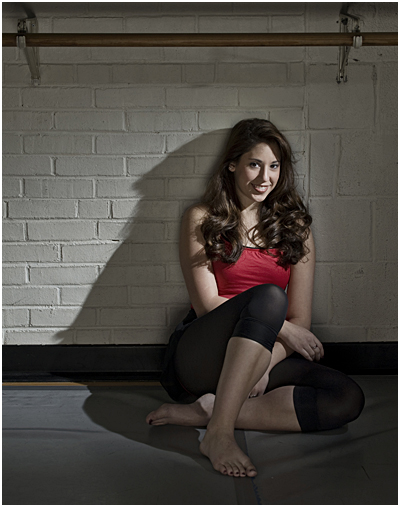
I am working on several projects this summer, the most enjoyable of which being a series of portraits for the Howard County Arts Council.
I photographed Kassi, a dancer, for this series and got a chance to play with one of the two-light techniques we talked about earlier. This was also the first chance I got to use a new boom setup that is a little heavier duty than the one featured earlier this week.
__________
Riaz Redux
I normally like to play around with new lighting styles before trying them out on an assignment. In this case, I used the small-flash lighting class in Dubai earlier this year as the guinea pig for this shoot. You might recognize the top photo as being lit similarly to that of Riaz, the first example in the two-light portrait series.
There are a couple of differences, but the grid key / umbrella fill was a common denominator for both. In shooting Riaz, I had the umbrella squished right up under the lens. With Kassi, I put the umbrella on the floor with a flash mounted to it but with no stand.
I used an umbrella swivel adapter to attach an SB-800, and stuck the assembly on the ground. The umbrella rests at about the correct angle for uplighting a low-to-the-ground subject by itself.
Ratios were done without a meter and without regard to any absolute settings, as usual. I positioned the fill light first and altered my flash power and/or aperture until I saw a nice baseline exposure for the frame.
Generally, I like to get it to a full exposure, and then drop my power level on the flash or close down the aperture until I get a nice looking floor to the fill light. The idea is to use the fill as a sort of safety net, to lift the shadows that will be formed by the key light, lest they get too dark and contrasty. If you are coming from off axis with the fill, you'll also introduce a second angle to the overall light.
I really liked the look of the low-in fill, as it gave its own shape to the subject -- much more so that would an on-axis fill. But as much as I liked the shape of the fill, I was going back and forth on the shadow that it threw over Kassi's head and shoulders.
In the end, I wanted the direction of the light, but not the shadow. So I toned the latter way down in post. There is definitely a procedural learning curve for me, even two full years after leaving the tightly controlled Photoshop environment of The Sun.
I have to remember to loosen up, as my default is typically to "do it the newspaper way." But then I remember if I were personally doing everything the newspaper way today, I would be drowning in debt and arbitrarily lopping off perfectly good body parts in a misguided attempt to get a "good return on investment."
 Oh well. Back to the light.
The key, as you can see, is a gridded SB-800. We have already locked in the fill level and shooting aperture, so the key level is set by altering the flash's power level. (We can also move the flash closer or further away, but that would change the look of the light.)
Unlike the grid on Riaz, I wanted to catch Kassi's face and body with the key but mostly miss the wall on the leading edge. This way I could control the tone in the white wall, even though she was leaning against it. To do that, I didn't aim the grid at her face, but rather out in front of her face a little bit. So her face is nearer to the edge of the beam than in the center of it.
A grid on a speedlight is a very small light source and thus produces very hard shadows at this distance. But I know they won't fall too far off of the table because I built my fill light first. The combination is soft vs. hard, high vs. low and tight light vs. everywhere light brings a lot of different contrast layers into play. If I wanted, I could have used a 1/2 CTB on the fill and a 1/2 CTO on the key to add a neat color contrast in there, too.
A Bigger Boom
 For another look, we wanted to do Kassi dancing. She is very athletic, and incorporates that into her routines. So we set up to light a photo of her leaping.
I knew she would be looking back over her shoulder at me, and wanted to light her face from a flattering angle. To do that, you have to find the position of her face and then get the light wherever it need to be to hit that angle.
In Kassi's case, to three-quarter light her, we'd have to be above, behind and camera-right of her face when she looked over her shoulder. So we were going to need to get the key up pretty high -- especially considering we'd be going through an umbrella, too.
For that I used a bigger, heavier-duty boom than the Interfit model we talked about earlier this week. I used a Paul Buff counter-weighted boom arm attachment on a 13-foot light stand. I got this to be able to get my bigger flash heads up high. And while it is not super heavy duty, it is sufficient for that kind of work.
You buy it in two pieces -- the stand and the boom arm. The stand is a heavy-duty, 13-foot stand, which is also a great thing to have kicking around when you need it. The boom assembly includes a two-section extension pole, a multi-angle clamp and comes with an 11-pound, slide-able counterweight. They total up to $160.
Needless to say, this is rock solid for a speedlight, and I also have been happy with it in a supporting role for both my SB's and my WL's.
 So, here's the setup. The key light is above/behind/camera right, through an umbrella. There is a back/separation light (an SB-800) hiding way back at camera right on a compact, 5-section stand.
The key light location was trial and error, done as Kassi worked through a few practice leaps. In the end, it was a perfectly logical location, given the position of her face. Kassi's leap put her about two feet in front of, and to camera left, of the umbrella.
The fill was a bigger problem, as we could not just open the shutter to let if build up the ambient. By balancing that way, we would have lost the shutter needed to freeze the leap. So it would all have to come from flash.
It had to be soft, come from close to on-axis and reach back to light the back wall, too. So I needed a physically big light source, coming from the camera's direction and pretty far back. Fortunately, our room was a neutral, light color, so the wall 15 feet or so behind me became my modifier.
 I fired a WL 600 into that wall, building a nice, soft, directionless fill that would be far enough back to reach back to the background wall without losing too much oomph. My shooting position was about three feet in front of the light.
If you are in a neutral room, always consider your walls as possible huge bounce surfaces that you can employ as everything from a soft key to a humongous soft ring-like fill. But you'll need some power if you are going to use it over a large area.
This is one of many examples of a way in which you can use a monobloc with smaller flashes. Ironically, the SB is my key and the WL 600 is the fill. This doesn't make a lot of sense, unless you consider how much more efficient a close-in, umbrella'd light is than another light bounced way back off of a wall and having to carry another 30-40 feet after that.
Having a big light in your back allows you wallpaper fill light over a large area while accenting with speedlights.
__________
Read More: On Assignment
__________
New to Strobist? Start here | Or jump right to Lighting 101
Now available in audiobook: The Traveling Photograher's Manifesto
Permalink
In-Depth: The New Fujifilm X100s
UPDATE: I recorded a ~40-min webcam walk-thru of the camera's best features and how to use them at the bottom of the post.

Short Version: It's a remarkable,
sync-at-any-speed camera with a no-apologies 16mp chip. I'll probably make more pictures with this camera over the next year than all of my other cameras combined.
Why, below.
Read more »
__________
New to Strobist? Start here | Or jump right to Lighting 101
Now available in audiobook: The Traveling Photograher's Manifesto
Permalink


